World War II
The GodfatherWorld War II functions in the novel as both an external historical upheaval and a pressure test for the Corleone Family’s private system of power. Don Vito Corleone prepares his criminal world to remain orderly and profitable while the larger nation enters war, but his youngest son, Michael Corleone, rejects the protection that family influence could provide and chooses military service instead. The war therefore enlarges the Don’s authority even as it reveals that Michael’s allegiance cannot be completely commanded.
Historical Crisis and the Don’s Strategic View
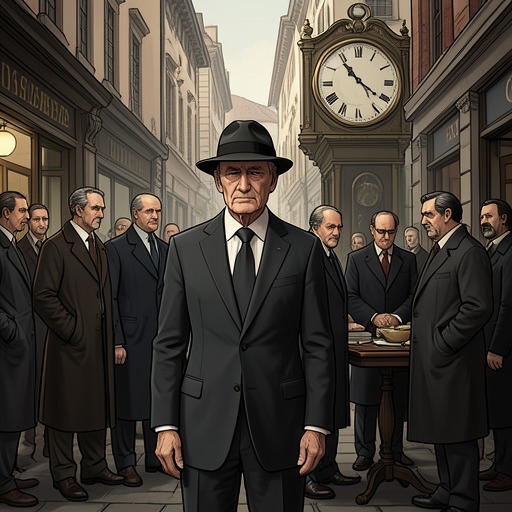
Don Vito Corleone watches the approach of global conflict from the position of a ruler guarding a separate political world. He observes the rise of Hitler, the fall of Spain, and Germany’s pressure on Britain at Munich, and he understands that war outside his domain may create both danger and opportunity. His central calculation is that peace must prevail within his territory while violence and uncertainty consume the wider world. The contrast is crucial: the Don does not treat World War II merely as a national emergency, but as a historical shift that can make his own organization more secure and more prosperous.
To prepare for that shift, Don Vito Corleone carries a message of peace across the United States. He confers with underworld leaders in Los Angeles, San Francisco, Cleveland, Chicago, Philadelphia, Miami, and Boston, eventually helping establish a working agreement among the country’s most powerful criminal organizations by 1939. The agreement preserves each organization’s internal authority while regulating spheres of influence and enforcing peace between them. World War II thus arrives after the Don has completed a form of criminal diplomacy: the conflict outside creates the conditions for profit, while the negotiated stability inside prevents the underworld from destroying itself.
Wartime Profits and Protection
When the United States enters the war in 1941, the world controlled by Don Vito Corleone is described as peaceful, organized, and ready to share in the economic gains of wartime America. The Corleone Family participates in the black market for OPA food stamps and gasoline stamps and in the distribution of travel priorities. Its connections can also help obtain war contracts and secure black-market materials for garment-center clothing firms denied sufficient raw materials because they lack government contracts. The family’s power is therefore shown not only through violence, but through access: it can move goods, influence bureaucracies, and turn scarcity into an organized source of revenue.
The same system extends to military manpower. Don Vito Corleone uses doctors to advise eligible men about drugs to take before physical examinations, and he places others in draft-exempt positions in war industries. Loyalty to the Don becomes a practical shield against the national demands of military service. Employees and associates can remain within the safety of his world while men outside it are sent into a foreign war, reinforcing the family’s image as an alternative government whose protection is more immediate than that offered by ordinary law.
Michael Corleone’s Defiance
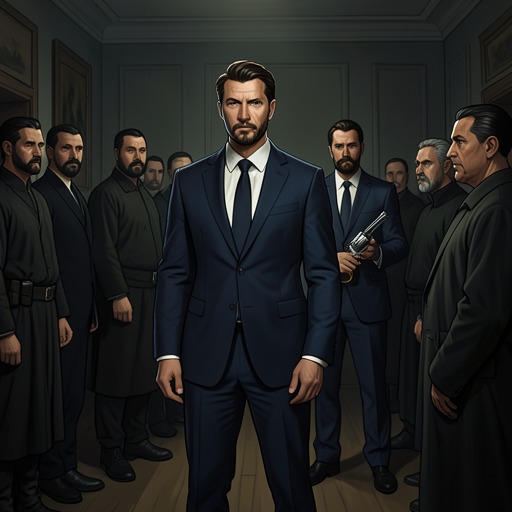
The family’s wartime arrangement fails to control Michael Corleone. Before the war, Michael had been the Don’s favorite and appeared to be the natural heir to the family business because he possessed quiet force, intelligence, and the instinct to command respect. When World War II began, however, Michael volunteered for the United States Marine Corps against his father’s explicit command. Don Vito Corleone did not want his youngest son killed in service to a power beyond the family. He bribed doctors, made secret arrangements, and spent considerable money trying to protect him, but Michael was twenty-one and determined to choose for himself.
Michael entered the war and fought over the Pacific Ocean. He became a captain and received medals, and in 1944 his photograph and an account of his actions appeared in Life magazine. Don Vito Corleone learned of the feature indirectly because the family did not dare show it to him; his response was that Michael performed such miracles for strangers. The remark condenses the father’s wound: Michael’s courage is undeniable, yet the Don experiences it as a refusal to honor the authority and protection of the family.
Michael’s military service also produces a second separation. After being discharged early in 1945 to recover from a disabling wound, he spends only a few weeks at home before entering Dartmouth College in Hanover, New Hampshire, without consulting anyone. He leaves his father’s house and returns only for the wedding of Constanzia Corleone, bringing Kay Adams to meet the family. At the wedding, the Don pays little attention to him, despite Michael’s former position as favored son and apparent heir. World War II has therefore transformed Michael from a possible successor inside the family into a man whose independent identity is built partly through opposition to it.
War, Loyalty, and the Limits of Power
Michael is not the only young man connected with the organization to resist the Don’s wartime arrangements. Some young members insist on serving because the United States has treated them well. When this explanation is reported to Don Vito Corleone, he angrily answers that he has been good to the man. The exchange reveals two competing ideas of obligation. The Don understands loyalty as a personal debt owed to the protector; the young man understands citizenship as a debt owed to the country. Although the Don is furious, he ultimately excuses these men as he has excused Michael, recognizing that his authority cannot simply erase their sense of national duty.
At the end of World War II, Don Vito Corleone knows that his own world must change again and fit itself more closely to the larger society. He believes this adjustment can occur without sacrificing profit, because his earlier experience has taught him to treat historical change as something that can be managed through foresight, alliances, and influence. Yet the war has already shown the danger in that confidence. The Don can arrange protection for associates, regulate criminal organizations, and exploit wartime markets, but he cannot make Michael accept the life prepared for him.
Narrative Significance
World War II clarifies the novel’s portrayal of the Corleone system as both protective and coercive. Don Vito Corleone helps poor people with jobs, relief, loans, and disputes with landlords, and the loyalty created by that help becomes political and organizational power. During the war, the same protective structure shields associates from the draft and channels restricted goods and contracts. Its benevolence and its self-interest are inseparable: protection produces allegiance, and allegiance sustains an alternative government outside ordinary law.
The war also sharpens the contrast between public law and private justice. Amerigo Bonasera’s faith in American law collapses when the courts fail to satisfy his demand for justice, leading him to seek Don Corleone’s intervention. Later, Don Corleone describes his criminal world as its own affair, insisting that its members must manage it themselves rather than submit to outside powers. World War II gives this claim a historical backdrop. The nation demands sacrifice in the name of public interests, while the Don’s order offers safety, profit, and personal obligation. Michael’s enlistment becomes the clearest refusal of that closed system, and his return from the war leaves the family facing a future in which the son most suited to rule has first learned to act beyond the Don’s command.